The most useful thing Meta announced this week was not another coding model. It was a receipt.
Muse Code is being talked about as a Claude Code rival, because that is the easy headline. Model versus model. Benchmark versus benchmark. Who writes the cleaner function. Who gets the pull request over the line. Fine, but that is not the important shift. The interesting part is that Meta has packaged persistent background agents, approval-aware plans, restart-safe work and a local event log that records model calls, tool runs, approvals and edits.
That is the grown-up bit.
The received wisdom is still that better agents need better prompts and better models. Give the system clearer instructions, buy the latest model, and hope the thing behaves. This is how most businesses are approaching AI deployment. They are treating the agent like a talented freelancer in a private chat window.
That breaks the moment the agent touches real work.
Once an AI can read a repository, edit a site, change campaign settings, touch CRM records, spend budget, send emails or publish content, the question is no longer "is the model clever?" The question is "can you prove what happened?" What did it read? What did it change? What tool did it call? Who approved the plan? Where did it get stuck? Can you replay the run? Can you recover after a crash? Can you roll back the work without guessing?
That is the line between a demo and an operating system.
The harness is becoming the product
The live signal is thin but pointed. The serious conversation around agents is moving towards durable execution, persistent memory, workflow replay, structured traces and access controls. Google's durable agent tutorial with Gemini and Temporal persists every model call, tool invocation and step so work can resume after a crash without repeating completed actions. OpenTelemetry's GenAI observability guidance shows how model calls, tool invocations, tokens and agent interactions can be captured as traces, metrics and events.
The people doing the work are converging on the same point: agent output is not enough. The harness around the agent is becoming the product.
That matters because most business AI rollouts are still being judged by the final answer. A document appears. A code change appears. A campaign draft appears. Everyone squints at the output and decides whether it looks plausible. That is not governance. That is vibe-based quality control with a nicer interface.
Foundry's position is simple: if an agent cannot leave a receipt, it should not touch the work.
What belongs in an agent receipt?
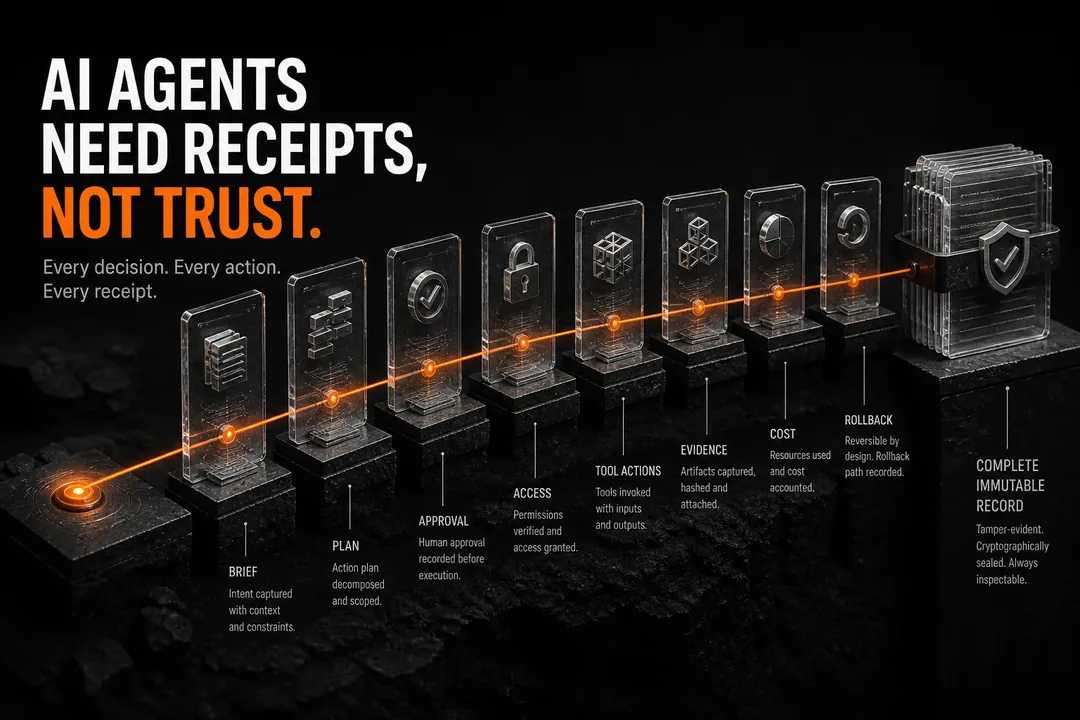
For a business, a receipt is not a cute audit log buried somewhere nobody reads. It is the operating record. The task brief. The plan. The approval gate. The files or accounts accessed. The tool calls. The evidence collected. The diff. The cost. The human interventions. The final decision. The rollback path.
This changes how you should buy and build AI systems. Stop asking only which model is best. Ask what happens when the run lasts four hours. Ask what happens when the browser crashes. Ask how two agents avoid editing the same thing at once. Ask whether sensitive data is used for training. Ask whether a junior team member can inspect the work without reading the agent's mind. Ask whether you can tell a client, regulator or board exactly what happened.
Add a receipt layer before more autonomy
This week, the practical move is boring and powerful: pick one agent workflow and add a receipt layer before you add more autonomy. Start with a task that already matters, maybe content publishing, code review, lead enrichment, reporting or paid media QA. Define the allowed tools. Require a written plan. Log every action. Capture evidence. Add a human approval point before any write surface. Store the final output with the run record.
Then measure the thing properly: completion rate, time saved, intervention load, accepted output, cost, rollback incidents and the quality of the evidence trail.
The model will keep changing. The receipt is what makes the work trustworthy.
Further reading
- The Edit Button Is Where AI Stops Being a Demo
- Code Agents Need a Blast-Radius Map
- AI Agent Workspaces Need Permission Design, Not Vibes
Building AI systems that people can trust with real work?
Book a strategy call →