The AI Agency Is the New Agency. Here's Why Traditional Agencies Are Already Dead.
This isn't a prediction about the future of marketing services. It's a post-mortem.
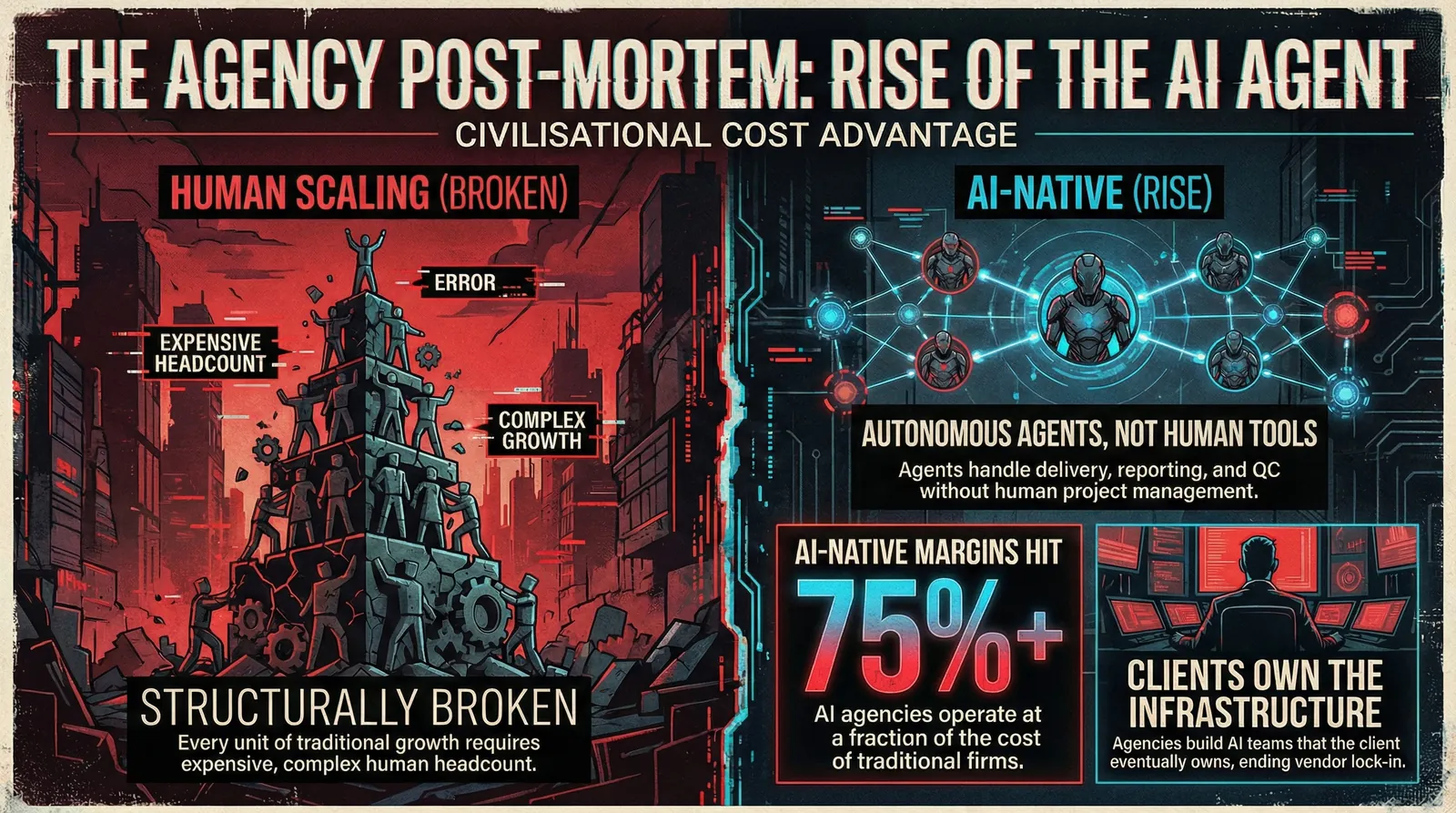
The traditional agency model — the one that's barely changed since the Mad Men era — is structurally broken. Not because the people are bad. Not because the work is poor. Because the economics are fundamentally unsustainable in a world where AI agents can do the work for a fraction of the cost, at a fraction of the time, without the overhead that kills margins and caps growth.
The disruption isn't coming. It already happened. Most agency owners just haven't looked at their P&L closely enough to see it yet.
The Numbers That Should Be Keeping Agency Owners Awake
A traditional agency operates on EBITDA margins of somewhere between 15% and 20% — on a good year, with tight management, decent client retention, and no unexpected attrition. Most are lower. The reason is structural: human-delivered services scale linearly. More clients means more people. More people means more management, more office space, more recruitment, more HR overhead, more training cycles, more sick days, more handover friction when someone quits.
Every unit of growth costs you another unit of headcount. The maths never gets better. It just gets more complex to manage.
Foundry Works — an AI-native agency operating right now, with live enterprise clients — runs fixed base costs of approximately £2,000 per month. Variable costs scale at around 3% of revenue. The result: EBITDA margins above 75%, maintained throughout the growth curve. Not a projection for when they "hit scale." From day one.
At £7.8M revenue in Year 5, operating costs are projected at £371,000. That's less than 5% of revenue. No traditional agency can approach that. Ever. Because they're carrying the weight of human infrastructure that grows with every new client they win.
The structural cost advantage of an AI agency over a traditional agency is not marginal. It's civilisational.
What an AI Agency Actually Is (And What It Isn't)
There's a lot of noise around "AI agencies" that are just traditional agencies with ChatGPT bolt-ons. A consultant who uses AI to write briefs faster. A social team that's automated scheduling with a tool. A content studio that replaced one copywriter with a prompt template.
That's not an AI agency. That's cost optimisation on the edges.
A true AI agency runs on agent architecture. Not tools that humans use — agents that operate autonomously, with defined roles, responsibilities, and escalation protocols. Agents that handle delivery, reporting, client communication, quality control, and performance tracking without a human needing to project-manage every touchpoint.
The distinction matters because it's the difference between shaving 20% off your cost base and restructuring the entire economics of how services are delivered.
At Foundry Works, the operating team isn't a roster of account managers and creatives. It's an agent workforce — Alex handling strategy and oversight, Ember managing SMB delivery, Cleo running day-to-day client operations, Ledger overseeing finance and reporting. They don't have salaries. They don't call in sick. They don't resign three months into a client engagement and take institutional knowledge with them.
And unlike any SaaS product competing in this space, clients don't rent a subscription. They own the infrastructure. When an engagement ends, the AI team and the systems it built belong to the client. No vendor lock-in. No ongoing licence fee. Capability, not dependency.
Why Traditional Agencies Can't Copy This
The obvious response from a traditional agency leader reading this is: "We'll just adopt AI tools and compete."
They won't. Not really. Not at the structural level that matters.
The problem isn't access to AI. Everyone has access to AI. The problem is that a traditional agency has existing cost structures it can't unwind overnight. Leases. Headcount. Notice periods. Client relationships built around human delivery. A brand identity tied to the people, not the process.
Adopting AI tools into a human-first delivery model creates incremental efficiency. It does not change the fundamental economics. You cannot bolt an AI layer onto a business designed around human labour and match the margins of a business built from the ground up on agent architecture.
This is the same dynamic that prevented high street retailers from competing with Amazon by building better websites. The advantage isn't the technology — it's the operating model that technology enables.
The agencies that survive this shift will be the ones that rebuild from the ground up. The ones that don't will spend the next five years watching their margins compress while wondering why they're losing pitches to teams that are a fraction of their size.
The Opportunity on the Other Side
Here's where this gets interesting — not just as a threat analysis, but as a genuine opportunity.
The AI agency model doesn't just win on cost. It wins on speed, consistency, scalability, and data. Agents don't have off days. They don't produce inconsistent work quality depending on who was in the room. They don't forget what was agreed in a brief six weeks ago. They don't need to be briefed twice.
For clients, the value proposition isn't "cheaper agency." It's "better outcomes with less friction." That's a harder pitch to resist than a 10% fee reduction.
And for the people building AI agencies right now — there's a window. Not infinite, but real. The market is in transition. Enterprise clients are actively looking for this capability. The agencies positioned to capture it in the next 18 months will establish relationships, proof points, and case studies that compound for years.
That window doesn't stay open indefinitely. The disruption is happening whether the industry is ready or not.
Foundry Works is an operational AI agency with live enterprise clients, four revenue engines, and 75%+ EBITDA margins built from the ground up on agent architecture. FNDRY is the token that powers it — revenue-backed, deflationary, and fair launch.
Own the work. Power the economy.
Read the full FNDRY whitepaper and see what an AI agency actually looks like in production.
foundryworks.ai